A Complete Guide to Your Cosmic Blueprint
Have you ever wondered why two people born under the same zodiac sign can seem like completely different people? One Scorpio is fiercely passionate and magnetic, while another is quiet, analytical, and reserved. One Gemini is endlessly social and outgoing, while another craves solitude and deep intellectual focus. If your Sun sign was supposed to define everything about you, how could two people sharing the same sign be so fundamentally different?
The answer lies in your natal chart — and once you understand it, astrology will never look the same again.
What Is a Natal Chart?
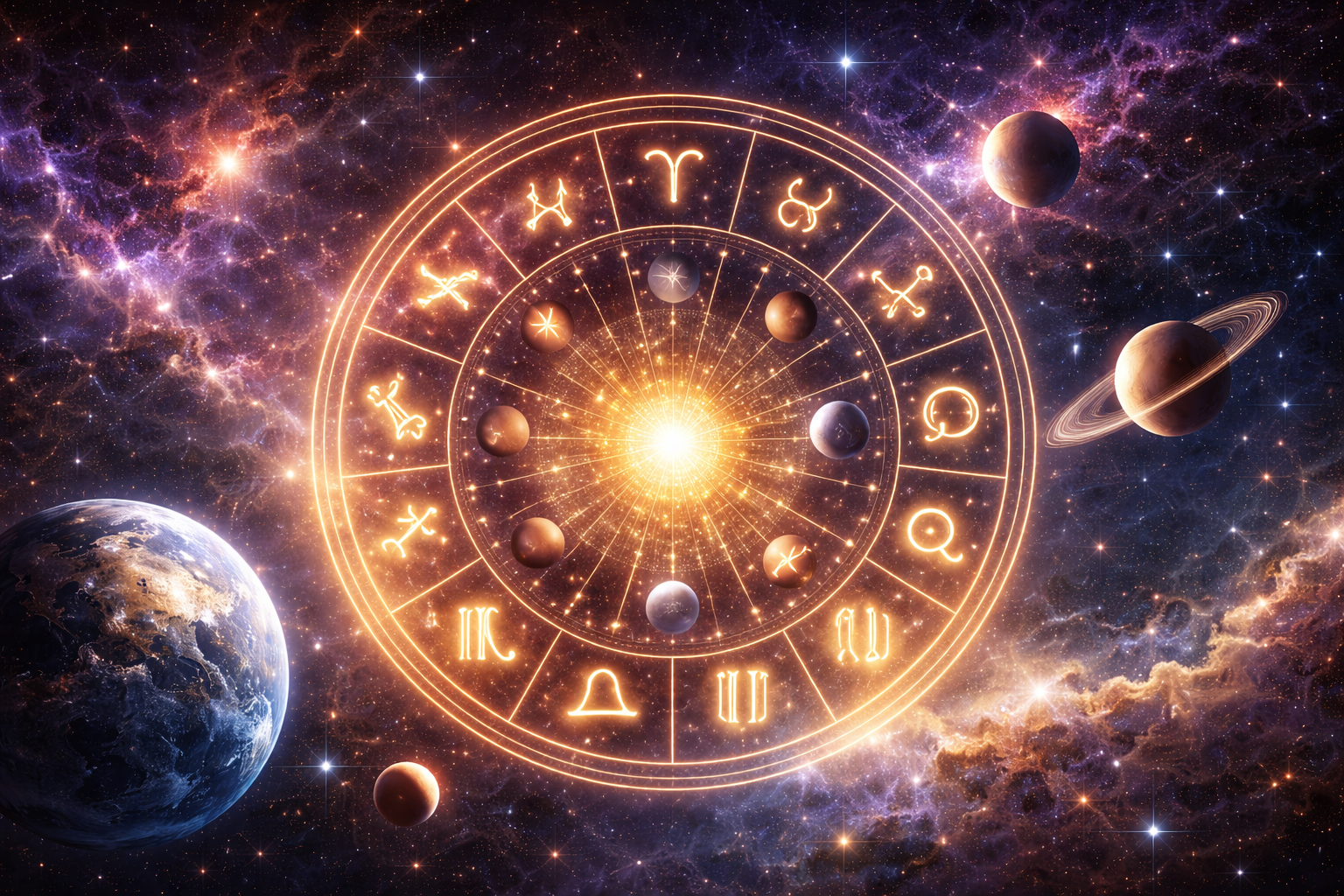
A natal chart, also called a birth chart, is a precise snapshot of the sky at the exact moment you were born. It captures the positions of the Sun, Moon, and all the major planets across the 12 zodiac signs and 12 astrological houses, creating a one-of-a-kind map that belongs only to you.
Think of it as the difference between a selfie and a full portrait. Your Sun sign — the zodiac sign most people know — is just a single pixel in a much richer image. Your natal chart is the full picture: your personality layers, emotional wiring, relationship patterns, career tendencies, deepest fears, greatest strengths, and the recurring themes that show up throughout your life.
Professional astrologers use natal charts to help clients understand everything from relationship compatibility and career direction to personal growth cycles and emotional blind spots. But you don’t need to be a professional to start reading your own chart. This guide will walk you through everything you need to know.
What You Need to Create Your Natal Chart
Before you can read your chart, you need to generate it. To create an accurate natal chart, you’ll need three pieces of information:
- Your date of birth — This determines which zodiac sign the Sun and planets were in at the time of your birth.
- Your exact time of birth — This is arguably the most important piece of the puzzle. The sky shifts constantly, and the precise moment you arrived in the world changes the structure of your entire chart. Your Rising sign (also called the Ascendant) moves through one zodiac sign approximately every two hours, meaning even a one-hour difference in birth time can completely alter your Rising sign and the layout of your houses.
- Your place of birth — Because astrology is calculated based on the local sky, your geographic location determines the angles of your chart.
If you’re unsure of your exact birth time, check your birth certificate, ask a parent or relative, or contact the hospital where you were born. Some countries record birth times routinely, while others do not. If you genuinely cannot find your birth time, you can still generate a partial chart using a noon time, but you’ll lose your Rising sign and accurate house placements.
Once you have these three details, you can generate a free chart instantly on sites like Astro.com or through any number of astrology apps.
The Big Three: Where to Start
If you’re brand new to natal charts, there’s no better place to begin than your Big Three — the three most foundational placements in any chart.
1. Your Sun Sign — The Core of Who You Are
Your Sun sign is the one most people already know. It represents your core identity, your conscious sense of self, your ego, and your life purpose. It’s the energy you’re here to embody and express in this lifetime.
If you’re a Sagittarius Sun, you’re driven by a desire for freedom, expansion, and truth. If you’re a Capricorn Sun, you’re here to build, achieve, and take on responsibility with discipline. Your Sun sign describes the essential fuel that powers your life — what gives you a sense of meaning and direction.
That said, the Sun sign alone is a starting point, not the whole story. It tells you what you’re here to become, but not how you go about becoming it. That’s where the rest of the chart comes in.
2. Your Moon Sign — The Emotional Landscape Within
While your Sun sign represents your outer identity, your Moon sign governs your inner world. It rules your emotional nature, your instinctive reactions, the way you process feelings, and what you need to feel safe, nurtured, and secure.
A person with a Taurus Moon craves physical comfort, stability, and routine. Sudden changes feel threatening to them, and they recharge through sensory pleasures — good food, nature, and quiet. Meanwhile, someone with a Gemini Moon feels most emotionally alive when their mind is constantly stimulated. They process emotions by talking them through, and they need variety to feel mentally healthy.
Your Moon sign often explains behaviors that seem to contradict your Sun sign. If your Sun is in bold, expressive Leo but you secretly crave alone time and feel emotionally overwhelmed in crowds — you might have an introverted Virgo or Scorpio Moon pulling you inward.
3. Your Rising Sign (Ascendant) — The Mask You Show the World
Your Rising sign is the zodiac sign that was rising over the eastern horizon at the exact moment of your birth. Unlike the Sun and Moon, which stay in a sign for days or weeks, the Rising sign changes every two hours — which is why birth time matters so much.
Your Rising sign shapes your outward personality: the first impression you give, your natural style of interacting with the world, your physical presence, and the instinctive approach you take to new situations. It’s sometimes called the “mask” you wear, but that doesn’t mean it’s fake. It’s simply the face that greets the world before people know you more deeply.
For example, someone with a Libra Rising tends to come across as charming, diplomatic, and aesthetically polished, even if their inner world (Moon) is turbulent and their core identity (Sun) is fiercely intense. Together, your Big Three interact to create the multi-layered person others experience when they meet you.
The 12 Houses: Areas of Life Experience
Once you’ve found your Big Three, the next layer to explore is the house system. The 12 houses divide your natal chart into 12 distinct areas of life, each governing a different realm of human experience. The placement of planets within these houses shows where their energy is most active in your day-to-day life.
- 1st House — Self, identity, physical body, first impressions
- 2nd House — Money, personal values, material security
- 3rd House — Communication, learning, siblings, short journeys
- 4th House — Home, family, roots, emotional foundations
- 5th House — Creativity, romance, children, play
- 6th House — Daily routines, health, work habits, service
- 7th House — Partnerships, marriage, one-on-one relationships
- 8th House — Transformation, intimacy, shared resources, the unconscious
- 9th House — Philosophy, travel, higher education, beliefs
- 10th House — Career, public reputation, ambition, legacy
- 11th House — Friendships, communities, future visions, social causes
- 12th House — Solitude, spirituality, hidden matters, the subconscious
If you have Venus in the 7th House, for example, love and beauty are strongly tied to your experience of relationships. If Saturn sits in the 10th House, career achievement may come through hard work, delayed recognition, and a gradual building of authority over time. Even empty houses carry meaning — the sign on the cusp of that house and its ruling planet still influence that area of your life.
Aspects: How the Planets Talk to Each Other
The final piece of the beginner’s puzzle is planetary aspects. Aspects are the angular relationships between planets in your chart, and they describe how different energies within your personality interact — whether harmoniously or with friction.
For beginners, these are the most important aspects to learn:
- Conjunction (0°) — Two planets are in the same location, blending their energies together. This can amplify their influence, for better or worse depending on the planets involved.
- Square (90°) — A tense, challenging angle that creates internal friction. Squares often represent areas where you feel stuck, conflicted, or driven to push against obstacles. They can be incredibly motivating if channeled constructively.
- Trine (120°) — A harmonious, flowing connection between planets. Trines represent natural talents and areas where things tend to come more easily to you.
- Opposition (180°) — Two planets pulling in opposite directions, creating a push-pull dynamic. Oppositions often show up in relationship dynamics and themes of balance.
A Simple Step-by-Step Reading Process
When you’re ready to sit with your chart, here’s a practical approach:
- Step 1: Identify your Big Three — Sun, Moon, and Rising. Write them down and read about each one individually before combining them.
- Step 2: Notice where your planets fall in the houses. Which houses hold the most planets? Those areas of life tend to be especially active and important for you.
- Step 3: Look at any major aspects, especially conjunctions, squares, and trines involving the Sun, Moon, or Rising sign. These reveal the core tensions and gifts woven into your personality.
- Step 4: Observe which zodiac signs are emphasized overall. If you have many planets in fire signs, passion and spontaneity likely run through everything you do. A chart heavy in earth signs points to practicality, patience, and a grounded approach.
What Your Natal Chart Cannot Do
It’s worth being honest about what astrology is — and what it isn’t. Your natal chart does not predict fixed events or lock you into a predetermined fate. It describes potential, patterns, and tendencies. What you do with those patterns is always up to you.
Two people with the same Rising sign and Moon sign can live entirely different lives based on their choices, environment, and awareness. Astrology is most powerful not as a system of prediction, but as a tool for self-understanding. When you see your own patterns clearly — even the difficult ones — you can begin to work with them rather than against yourself.
Final Thoughts
Your natal chart is one of the most profound tools for self-reflection available to you. It honors your complexity, names patterns that may have confused you for years, and offers a language for understanding why you move through the world the way you do.
Start with your Big Three. Sit with them. Then, when you’re ready, let your curiosity pull you deeper — into the houses, the aspects, and the subtle dance of planets that makes your chart uniquely yours.
The cosmos went to great lengths to arrange the sky exactly as it was in the moment you arrived. Learning to read that arrangement is simply learning to read yourself.